


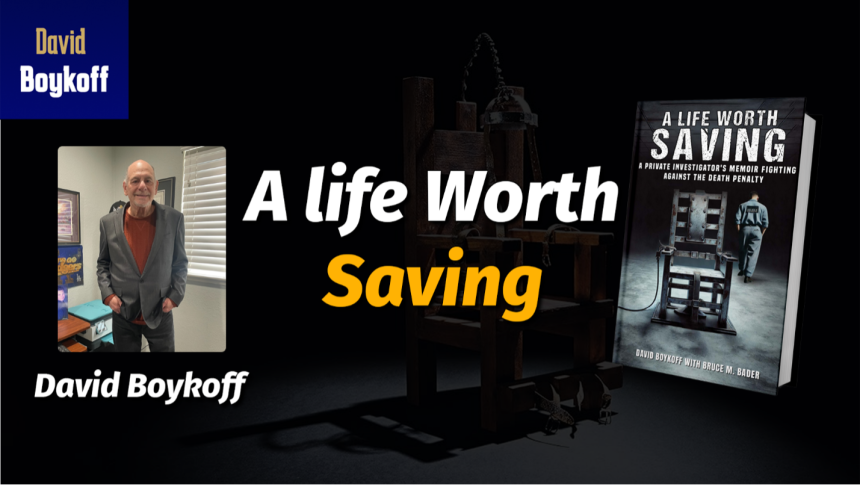
For nearly four decades, David Boykoff stood between the justice system and its ultimate punishment. As a mitigation specialist, his job was to present the human side of those facing the death penalty—to find reasons, histories, traumas that might convince a jury to spare a life.
Now retired, Boykoff has turned his life’s work into a gripping, unflinching memoir: A Life Worth Saving. The book blends high-stakes courtroom drama with deeply personal revelations, challenging readers to reconsider everything they think they know about crime, punishment, and redemption.
A Past He Refuses to Hide
Born in 1953 in Brooklyn’s Bayview housing projects, Boykoff grew up in a household defined by emotional abuse and racism. His alcoholic father tore down his confidence and instilled in him a worldview fueled by prejudice and fear. “I was born a racist,” Boykoff writes, plainly. “That’s what I was taught to be.”
Rather than bury that legacy, Boykoff confronts it head-on in his memoir. His story is not one of easy reform, but of gradual reckoning. “Helping people of color who I once viewed as beneath me,” he says in a recent interview, “became my path to redemption.”
From Surveillance to Saving Lives
Boykoff’s early years as a private investigator weren’t noble. He started in the shadows of the industry—insurance scams, shady tactics, and surveillance tricks. But when he discovered criminal defense investigation, something shifted.
Eventually, he found his calling in capital murder trials, specifically in the penalty phase—the part that comes after a guilty verdict, when a jury must choose between life in prison and death. That’s where mitigation comes in.
Mitigation isn’t about proving innocence. It’s about providing context. Boykoff and his team would gather testimonies, school records, medical histories—anything that might help jurors understand who the defendant was before the crime. “I had to humanize someone who had just been convicted of murder,” he explains. “Not to excuse their actions, but show the jury why that person might still be worth saving.”
The Cases That Defined Him
The book is structured around some of the most intense cases of Boykoff’s career. In one early story, he works on the case of a former LAPD officer charged with murder and robbery. The man had been hired as a hitman. “It was a five-year case,” Boykoff says, “and it was all over the news. That was when I knew I had stories people needed to hear.”
But not all clients inspired sympathy. In Chapter 5, titled Raging Bull, Boykoff recalls Stephen Jones, a client he describes as irredeemable. “He couldn’t control himself. He threatened judges. He was violent in court. Even I had to admit—he may have deserved death.”
That conflict—between belief and reality, between idealism and human danger—is what makes Boykoff’s perspective so compelling. He never lets ideology override truth.
The Psychology of Crime
In A Life Worth Saving, Boykoff makes the case that many people facing death row are more tragic than they are evil. Nearly every chapter highlights childhood trauma: physical abuse, abandonment, and untreated mental illness. One client was beaten regularly and hung in a closet for hours. Another was abandoned while his mother entertained clients in the next room.
“These aren’t excuses,” Boykoff says. “But they’re explanations. If you want to understand why someone ended up in a gang or committed a murder, you have to look back—way back.”
The memoir digs into the social and economic failures that shape violent lives. Many of Boykoff’s clients were raised in broken homes, underserved schools, or foster systems that failed them. “They weren’t born monsters,” he says. “They were shaped.”
Fighting a Broken System
Boykoff doesn’t just take aim at individual injustice. He takes issue with the entire death penalty system.
“It’s not a deterrent. It’s not cost-effective. And it’s not fair,” he says. “People of color face the death penalty more often and get sentenced more quickly.”
During his career, Boykoff took pride in keeping over 30 clients off death row. “That was my version of success,” he says. “Not winning a case, but saving a life.”
His views echo widely held criticisms of capital punishment: racial bias, wrongful convictions, exorbitant legal costs, and the emotional toll on everyone involved. California, where he worked, hasn’t executed anyone since 2006—and yet, new district attorneys still occasionally seek the penalty. Boykoff sees this as political, not moral.
A Memoir That Doesn’t Let You Look Away
A Life Worth Saving is not easy reading. It’s blunt, unsentimental, and often uncomfortable. Boykoff doesn’t paint himself as a hero. He shows the mess of the justice system, of his own upbringing, and of the people he’s tried to help.
But that’s exactly what makes it resonate.
He’s not asking for forgiveness. He’s asking readers to look deeper—beyond mugshots, beyond headlines, beyond verdicts—and ask themselves a simple but provocative question:
“Is this life worth saving?”
Final Thought
In a genre crowded with thrillers and crime stories, A Life Worth Saving stands out not because of who dies—but because of who lives. It’s a rare, clear-eyed look at the humanity behind the headlines, written by a man who once judged harshly, then chose to understand.