
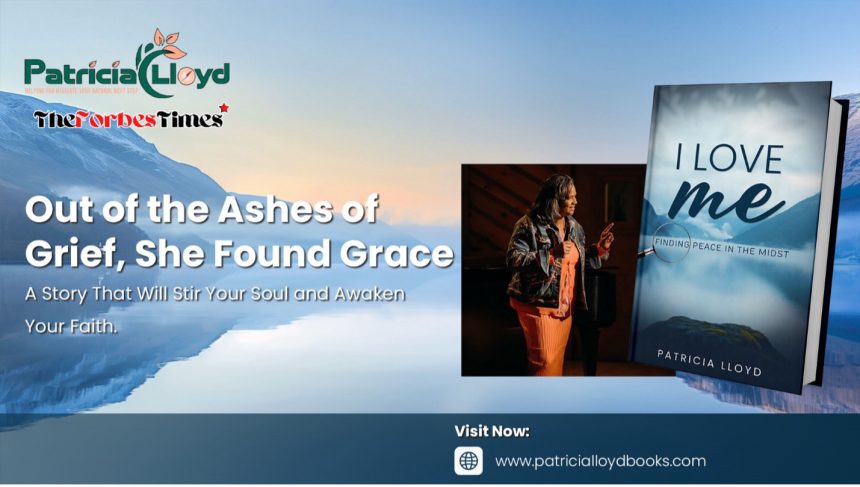
With her book “I Love Me,” the first-time author transforms personal pain into a roadmap for emotional and spiritual restoration.
Patricia Lloyd didn’t write her book overnight; it took ten years and a lifetime of learning what not to carry.
Her debut adult title, I Love Me: Finding Peace in the Midst, is equal parts memoir, spiritual reflection, and call to action. But behind its polished pages is a story of raw perseverance; a woman emerging from the wreckage of a toxic marriage and years of internalized pain to discover something many never do: that true healing starts with love, but not the kind directed outward.
It starts with learning to love yourself, wholly, honestly, and without apology.
“Most people, after trauma, don’t realize what they’re really carrying,” Lloyd said in a recent interview. “I didn’t either. I just knew I was tired. I had to unpack the pain I’d stuffed away for so long.”
The metaphor that structures her entire book is deceptively simple: a bag of rags. In a vivid dream that opens I Love Me, Lloyd finds herself as a bride, one who has forgotten to buy a dress. When someone checks her garment bag, it’s filled not with satin or lace, but old, tattered fabric. It’s a moment that could read as surreal, even absurd, if it didn’t cut so close to home.
“Those rags were symbolic of every hurt, every disappointment I didn’t know how to process,” she explains. “It was emotional baggage I kept pretending wasn’t there.”
As the book unfolds, the dream becomes a blueprint for growth. Those rags — which once represented failure and shame — are gradually transformed. Lloyd recounts, both literally and symbolically, how she began cutting those rags into squares and stitching them together to form quilts for her children and herself. The result: tangible symbols of renewal and legacy.
“I turned brokenness into beauty,” she says.
But I Love Me isn’t just about transformation. It’s about accountability. It challenges readers to reflect on their role in their own healing. Each chapter ends with a “Challenge Question,” prompting deep internal inventory: What gift or talent have you been hoarding? What strongholds keep you wandering? What have you delayed out of fear or disbelief?
These are not rhetorical. Lloyd doesn’t just want to inspire; she wants to activate.
The writing process was not straightforward. Lloyd admits to delaying the book for years, not from laziness but fear. She was still healing. She didn’t want to cause collateral damage to people in her past — including the father of her children — nor did she want her pain to bleed onto others.
“I never wanted my journey to become someone else’s shame,” she says. “That was one of the most emotionally difficult aspects — protecting others while telling the truth.”
Despite its heavy themes, I Love Me is filled with light. Lloyd’s voice, both on the page and in conversation, is warm, grounded, and refreshingly humble. Her storytelling style draws from her background as a teacher and counselor in faith-based communities across several states, including Ohio, Wisconsin, and Texas. These communities, she says, were essential in her recovery.
“Community is everything — when it’s healthy,” she says. “Workshops, classes, mentors… they helped me detox from toxic thinking. I had to unlearn what I thought was normal.”
What sets Lloyd’s story apart is her unflinching honesty about the complexity of healing. It’s not a single moment of epiphany — it’s a daily, ongoing recalibration.
She compares it to addiction recovery: “Even after the drugs are gone — and in my case, shopping was the drug — the patterns of thinking linger. You have to choose healing every single day.”
Much of Lloyd’s resilience is rooted in her faith. Raised in a devout Christian household, she often refers to biblical concepts of obedience, purpose, and grace. But I Love Me isn’t just for believers. Its core message — that you are worthy, valuable, and capable of healing — transcends religious boundaries.
In fact, one of the most profound moments she shares is her realization that God loves her, personally and intimately.
“That moment broke me,” she says, voice trembling. “I knew God loved people in general. But realizing He loved me — that changed everything.”
That realization, she says, redefined how she approached others. “When you really love yourself, you can’t mistreat anyone. The pain we project is often pain we’ve ignored in ourselves.”
This principle — that we serve best when we’re whole — is another core tenet of the book. It’s what she means when she talks about moving from “me” to “we.” By investing in her own healing, Lloyd says, she finally became someone capable of truly helping others.
At 66, Lloyd isn’t slowing down. With the release of I Love Me, she’s stepping into a new phase of purpose — speaking, mentoring, and guiding others through their own healing journeys. Her goal is simple: help others bypass the detours she took.
“If my story can help someone else find their way out of the fog, then everything I went through wasn’t in vain.”
She’s also laying the groundwork for a follow-up: a companion workbook and a broader platform to engage in community healing through workshops and group counseling.
But at the heart of it all is one unshakable belief: that the pain we endure doesn’t define us — how we repurpose it does.