
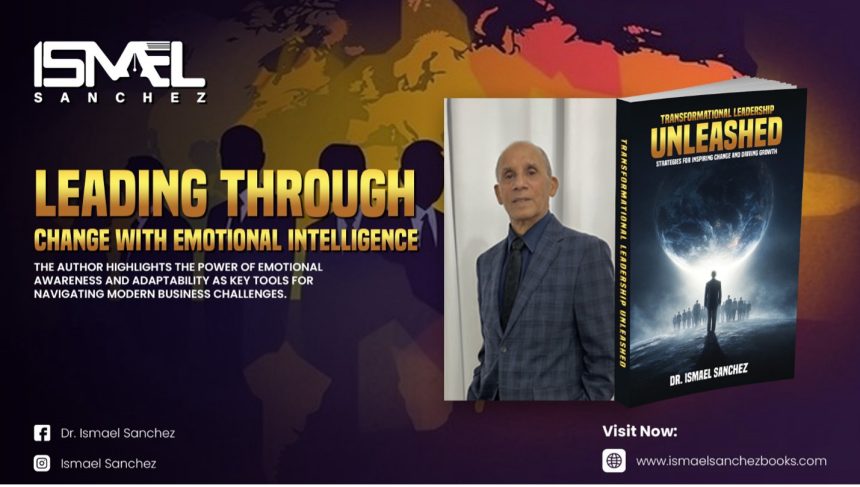
In a time when organizations face constant disruption and uncertainty, few voices speak with the clarity and conviction of Dr. Ismael Sanchez. A veteran educator, ordained bishop, and seasoned community leader, Sanchez has spent more than four decades guiding institutions, mentoring leaders, and advocating for purposeful transformation. Now, with the release of his new book, Transformational Leadership Unleashed: Strategies for Inspiring Change and Driving Growth, he delivers not just a leadership manual, but a heartfelt roadmap for personal and organizational renewal.
Born in Fajardo, Puerto Rico, in 1943, Sanchez’s life journey spans military service in the U.S. Army, decades in New York’s educational system, and spiritual leadership across multiple congregations. His credentials are as impressive as they are varied: a Ph.D. from York Christian International University, a master’s in Adult Education from City College of New York, and ongoing doctoral work at Phoenix University.
But it’s not his résumé that defines his leadership philosophy; it’s his relentless focus on people.
“Leadership isn’t about authority, it’s about connection,” Sanchez said in a recent interview. “It’s not about command. It’s about understanding, inspiration, and shared growth.”
That conviction forms the backbone of Transformational Leadership Unleashed, a book that challenges outdated, top-down management models. Drawing on his experiences in education, ministry, and community service, Sanchez argues for a leadership style grounded in emotional intelligence, empathy, and shared purpose.
The book offers a striking contrast to transactional leadership, the familiar carrot-and-stick method still prevalent in many organizations. Where traditional models emphasize control and compliance, Sanchez champions a dynamic, evolving process that cultivates future leaders through trust, modeling, and empowerment.
“I’ve seen many leaders struggle,” he noted. “Not because they lacked skills, but because they lacked clarity, relational depth, a compelling vision, or emotional insight. My goal was to offer a framework to change that.”
His approach is deeply practical. In one telling example, Sanchez recalls inheriting a struggling admissions team at a New York college. Rather than manage from behind a desk, he moved his office into the team’s workspace. He led recruiting efforts side by side with staff, rotated leadership responsibilities among team members, and created an environment where everyone felt seen and empowered.
The results were immediate: morale improved, recruitment numbers rose, and team cohesion strengthened.
The book elaborates on strategies like these across ten chapters, addressing everything from vision-casting and team motivation to innovation and accountability. Throughout, Sanchez returns to several key principles: empathy, clarity, courage, and shared leadership. He also emphasizes the role of emotional intelligence, not just in reading others, but in leading oneself.
“People don’t always say what’s on their minds, but their body language, their energy, it tells a story,” he said. “As a leader, you have to listen with more than your ears. You have to be tuned in emotionally.”
What sets Transformational Leadership Unleashed apart is its accessibility. While the content is rooted in academic and professional insight, it’s written with the practitioner in mind, educators, mid-level managers, pastors, and anyone tasked with guiding teams or communities. It’s a guide not just for executives, but for those on the front lines of leadership, often navigating cultural shifts, generational gaps, and emotional exhaustion.
Sanchez’s message is especially relevant now, as the post-pandemic workplace continues to evolve. With hybrid models, remote teams, and increased emphasis on mental health and purpose-driven work, the command-and-control style of leadership feels more obsolete than ever. Employees no longer respond to rigid authority; they seek meaning, mentorship, and mutual respect.
Sanchez doesn’t shy away from the challenges transformational leaders face: burnout, disconnection, and resistance to change. But he sees these not as obstacles, but as opportunities to deepen engagement and ignite growth.
“People want to feel part of something bigger,” he said. “When your leadership gives them purpose and a sense of belonging, they don’t just comply, they commit.”
This philosophy is especially impactful given Sanchez’s dual roles in both secular and spiritual institutions. As an International Bishop overseeing churches in and outside the U.S., he has mentored leaders not only in business and education, but in faith-based communities. His ability to move seamlessly between boardrooms, classrooms, and pulpits gives his insights unusual breadth.
What makes Sanchez’s work especially compelling is how rooted it is in lived experience. His leadership isn’t theoretical; it’s personal. From mentoring young professionals to restructuring college departments, he has consistently led by example, often stepping in where systems were broken or morale was low.
And at 82, he’s not slowing down. Between author events, speaking engagements, and his ongoing doctoral research, Sanchez remains committed to what he calls “the ministry of leadership”, a mission to inspire, uplift, and prepare others for positions of influence.
With Transformational Leadership Unleashed, Sanchez delivers more than a book. He offers a call to action: for leaders to be more human, more present, and more courageous in shaping the future of their organizations and communities.
“Leaders aren’t born. They’re made,” Sanchez often says. “And they’re made through intentional relationships, self-reflection, and a commitment to grow.”
As leadership paradigms continue to shift in the face of global change, Sanchez’s message could not be more timely, or more needed.