


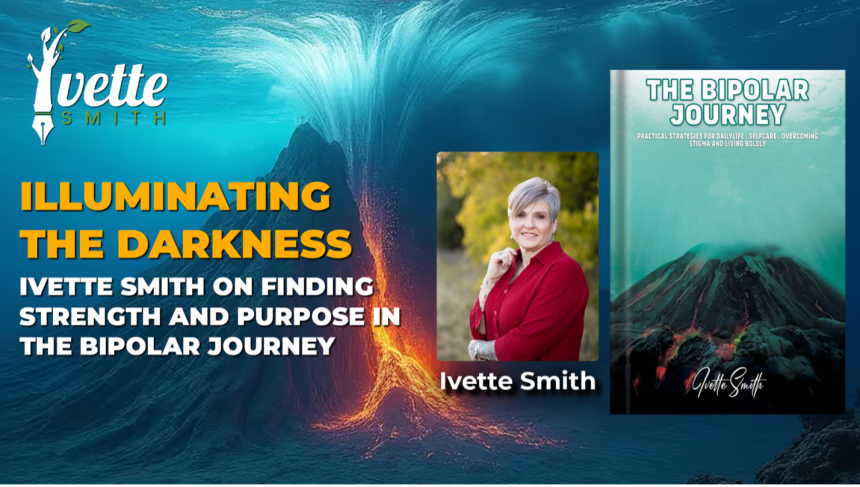
When Ivette Smith was first told she had bipolar disorder, it felt like her world had been cracked open. What began as confusion and fear slowly transformed into a journey of self-discovery, resilience, and light. In her heartfelt interview, Smith reveals how The Bipolar Journey was born not only from her diagnosis, but from decades of learning to coexist with the condition—and to grow through it, not despite it. Ivette’s turning point came during a difficult chapter of her life: recovering from a shoulder injury that left her confined and soulful. “When you don’t have a whole lot to do,” she recalls, “you think about a lot of things.” While reading a devotional, she realized that sharing her experience could serve a greater purpose—to give others hope and practical guidance. Over thirty years of navigating bipolar disorder had taught her that healing is not linear—it’s an ongoing evolution of self-awareness and courage. That realization inspired her to write The Bipolar Journey, a compassionate route that combines lived experience with practical tools. The book, she explains, is meant to help others “take comfort in the fact that this will pass… you’ll shape it, you’ll make it what you want, as much as you can”.
Smith admits that, for a long time, she identified herself primarily by her condition. “Short of saying, ‘Hi, I’m Ivette, and I’m bipolar,’ that’s how I introduced myself,” she says with candor. But writing the book became her act of reclaiming identity. She came to understand that one’s life cannot be reduced to a label or diagnosis. “You have to have a purpose in life,” she expresses, “because that’s the only way to move forward and improve yourself as a person.” This theme connects throughout her book, particularly in the chapter “From Surviving to Thriving: Real-Life Success Stories,” where she celebrates individuals who, like her, turned their challenges into fuel for transformation. One of the most striking elements of both the interview and the book is Smith’s reframing of bipolar disorder as a “superpower.” She explains that her creative surges often emerge during manic phases, while depressive episodes deepen her empathy and reflection. “Both extremes are bad,” she admits, “but in between those extremes are little grades. On the happy days, I’m efficient, active, and doing things with enthusiasm.”
Her honesty about the “emotional whiplash” that comes with the condition is refreshing. She emphasizes the need for understanding and communication in relationships, acknowledging that partners and loved ones “have to keep up with your ups and downs.” Yet, she sees vulnerability as a bridge, not a burden. In moments of despair, the simple act of having someone’s shoulder to cry on, she says, can be transformative. Faith plays a quiet but significant role in Ivette’s healing process. Although she does not align with a particular denomination, she finds strength in spirituality: “There’s a higher force you can always tap into—and it helps.” Her approach conveys the book’s holistic view, which blends medical, emotional, and spiritual wellness. In chapters such as “Building Resilience: Strategies for Long-Term Stability,” Smith explores mindfulness, journaling, and gratitude as vital anchors. She even speaks candidly about her chase of natural alternatives to medication, focusing on nutrition and holistic care. “I’m trying to eat healthier,” she shares, “seeing if I can liberate myself from these chemicals and still live a full life.” Her perspective echoes the book’s recurring message—that recovery is deeply personal and multifaceted, requiring experimentation, patience, and self-kindness.
Smith’s thoughts on relationships are strongly moving. In both her writing and her interview, she emphasizes the importance of open dialogue and moral support. “Sometimes,” she says softly, “you just need a shoulder to cry on. You don’t need words. Just presence.” In “Managing Relationships and Bipolar,” she expands on this belief, illustrating how understanding and patience can turn moments of conflict into opportunities for closeness. Through vulnerability, she argues, we find authentic connection—a sentiment that resonates beyond mental health and into universal human experience. When asked what single lesson she hopes readers take from The Bipolar Journey, Ivette’s response is simple yet powerful: “That there is a light at the end of the tunnel… this too shall pass. Keep walking toward that light, and you’ll get out of this tunnel.” Her words embody the essence of her book—a blend of realism and hope, pain and perseverance. The closing chapters of her book mirror this outlook, urging readers to shift from merely surviving to living boldly. With sections on advocacy, creativity, and future planning, Smith encourages readers not only to manage their condition but to thrive with it.
Above all, Ivette Smith’s mission is to break down stigma. Her advice for those beginning their advocacy journey is calm but powerful: “Don’t get angry… forgive them, for they know not what they do.” Education and empathy, she believes, are stronger tools than confrontation. Her message echoes throughout The Bipolar Journey, especially in “Fighting the Stigma: Strategies for Personal Advocacy,” where she calls for compassion—both toward oneself and others. By choosing understanding over resentment, she reminds us that healing begins with grace. Ivette Smith’s The Bipolar Journey and the story behind it are evidence of courage, transformation, and authenticity. Her words bridge the gap between pain and purpose, reminding readers that mental illness does not define a person—it refines them. Her life, much like her book, radiates a single firm truth: resilience is not the absence of struggle, but the art of turning struggle into strength. Through candor, humor, and humanity, Ivette invites us to see bipolar disorder not as a life sentence, but as a journey—one that can lead to creativity, connection, and light.