
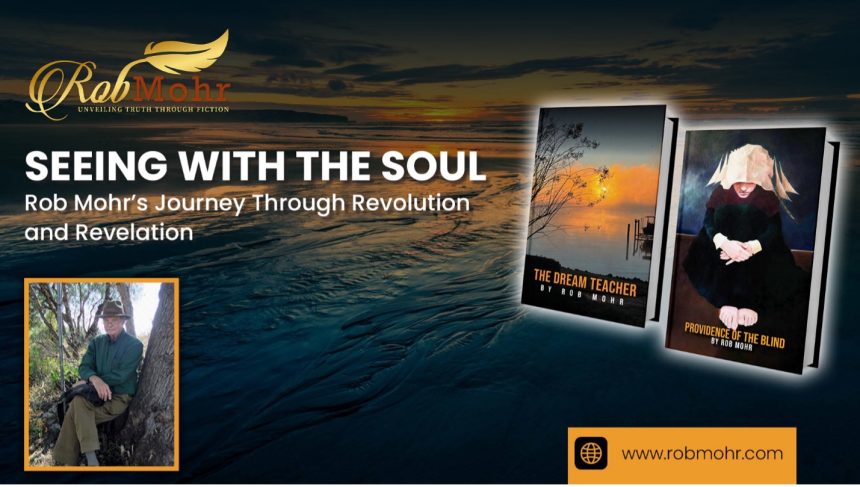
What if storytelling could pull back the curtain between the physical and spiritual worlds—and reveal the truths we’ve often overlooked? That’s the question Rob Mohr asks readers to face in his two thoughtful and socially aware novels, The Dream Teacher and Providence of the Blind. Together, these works don’t just entertain—they inspire change. From the revolutionary hills of Bolivia to the shadowy streets of a troubled future America, Mohr uses fiction as a mirror, showing not only the world around us but also the world inside us.
Rob Mohr didn’t set out to become a novelist in the traditional sense. His roots lie in the visual arts. A painter by profession, he exhibited in New York City and taught as an artist-in-residence at the University of Georgia. But beneath the brushstrokes was always a storyteller waiting to emerge. “I was also a storyteller,” Mohr said in a recent interview, explaining how his love of narrative grew from short stories and academic writing into full-length fiction. His global experiences—from living in Ecuador and working in Bolivia, to his strong involvement in native community education—gave him not just stories to tell, but truths to share.
Mohr’s first novel, The Dream Teacher, is a powerful, detailed story that mixes real-world politics with spiritual understanding. The story follows Marcus Stewart, an American teacher working in the unstable setting of Bolivia during a harsh right-wing uprising. Marcus’s goal is to support native Quechua communities through informal education. But as the government grows more controlling, Marcus is pulled into a dangerous prophecy that challenges his loyalty, bravery, and understanding of what is real. What makes The Dream Teacher more than just a political story is Marcus’s unusual spiritual awareness—his ability to sense good and bad in others. This idea, influenced by Mohr’s own advanced studies in spirituality, brings a stronger, thoughtful layer to the novel. “We seldom wake up to the spiritual, which is just as real,” Mohr explained. Through Marcus, the reader is urged to see history not just as a series of events and violence, but as a clash of moral and spiritual powers.
Drawing inspiration from Paulo Freire’s Pedagogy of the Oppressed, the novel also critiques the destructive influence of capitalism and foreign intervention in Latin America. The tension between Marcus’s humanitarian goals and the rising tide of militarism shows a painful reality Mohr witnessed firsthand. “I used non-formal education to enable them to wake up to their own potential,” he said of his time working with native communities in South America. That awakening is central to The Dream Teacher—both for the characters and the readers. Mohr doesn’t shy away from emotional cost either. Marcus’s internal conflict over leaving his wife and children back home is a recurring thread that humanizes his struggle. Through the voice of Catherine, Marcus’s wife, we hear the heartbreak and isolation that come from living between two worlds—one personal, one political. The sacrifice isn’t romanticized—it’s real, raw, and reflective of the consequences that come with purpose-driven lives.
While The Dream Teacher is rooted in historical conflict, Providence of the Blind shifts to a prophetic vision of a future America teetering on collapse. The novel centers on James Scott, a man gifted with the ability to feel the spiritual essence—good or evil—within people. In a society fractured by extremism, violence, and apathy, James is both observer and resistor, led by a mysterious spiritual force he calls providence. Set in both Manhattan and Europe, the novel reads like a philosophical thriller—a warning wrapped in poetic prose. Through James’s journey, Mohr exposes how modern society, driven by greed and manipulated by politics, loses its soul. “The world is gradually being molded into a homogeneous culture,” James shows in the book, “one that is flat and lacks the depth that once made humans a creative force in the world.” While Marcus Stewart works for change through education, James Scott pushes back against cultural decline through personal understanding. He is not only aware of outside danger but also of unseen spiritual forces. For Mohr, this isn’t make-believe—it’s a comment on the real-world gap between progress and meaning, politics and conscience.
Though they differ in setting, time, and tone, The Dream Teacher and Providence of the Blind share a heartbeat. Both novels blur the line between the spiritual and political, between personal choice and collective fate. Their main characters—Marcus and James—are seekers of truth, caught between systems that suppress and inner voices that guide. Through Marcus, Mohr discovers the power of action. Through James, he explores the power of awareness. And through both, he delivers a message that transcends genre: awakening is not optional. Whether through revolutionary education or spiritual discernment, the call is the same—wake up, see the world clearly, and act with courage.
For Rob Mohr, writing is more than an art—it’s a mission. “I try to help the reader grow mentally,” he says, describing his goal as both literary and spiritual. He writes to open eyes, not just minds. His novels display a lifetime of artistic expression, social justice work, and strong spiritual inquiry. And in a time when distraction is easy and truth is slippery, Mohr’s fiction insists on honesty. The Dream Teacher and Providence of the Blind are not just books. They’re experiences—stories that invite you to see with the soul.